Sacred Waters
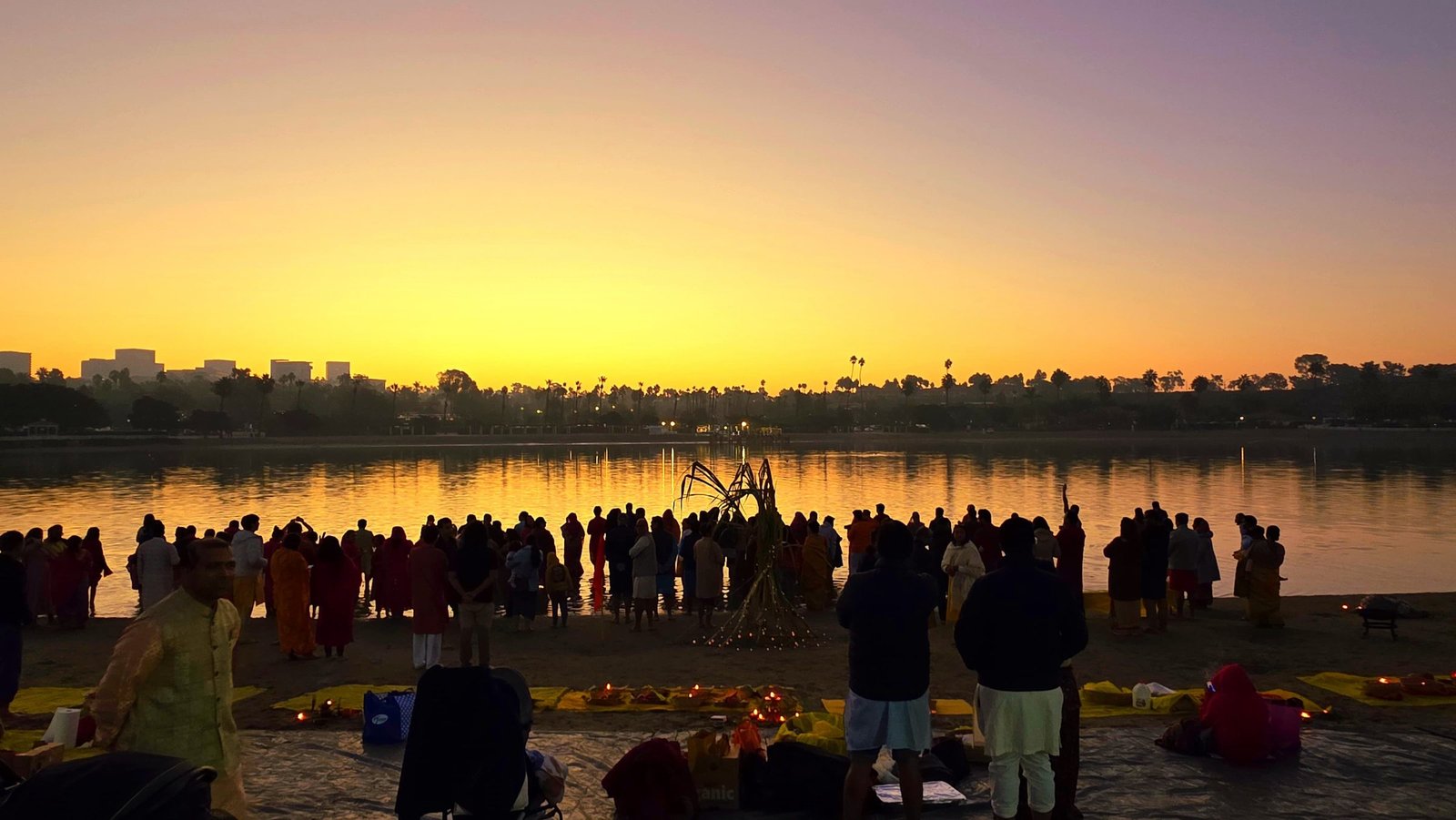
Purification through immersion in rivers, lakes and ponds — here, the Pacific and our local lakes.
Chhath is measured in sunrises. Here is what happens on each of the four days, and what every offering means.
Holy bathing, cleansing of the home and a satvik meal cooked in bronze or earthen vessels over mango wood.
Friday 13 November · at home
A day-long fast broken at dusk with gud ki kheer, wheat roti and fruit — after which the 36-hour Nirjala Vrat begins.
Saturday 14 November · at home
Families gather at the water in traditional attire, offering soop and daura filled with thekua, sugarcane and fruit to the setting sun, singing Chhath geet.
Sunday 15 November · 4:30–7:00 pm
The final offering to the rising sun. The 36-hour fast concludes with paran, bringing blessings of health, harmony, prosperity and new beginnings.
Monday 16 November · 5:30–8:30 am
Everything is satvik — made at home, without onion, garlic or salt, and never tasted before it reaches the sun.
Wheat flour, jaggery and ghee, pressed in wooden moulds and fried — the heart of the offering.
Whole stalks arched over the soop, offered to the sun.
Coconut, banana, sweet lime, singhara and whatever the season gives.
Rice cooked in jaggery and milk — the meal that breaks Kharna.
Unpolished rice, cooked without salt for Nahay-Khay.
Handwoven bamboo winnow and basket that carry everything to the water.
Purification through immersion in rivers, lakes and ponds — here, the Pacific and our local lakes.
Arghya offered to Surya Dev at sunset and again at sunrise, standing waist-deep in water.
Pure vegetarian prasad prepared without onion, garlic or salt — thekua above all.
Devotional folk songs carried across generations, sung together at the water’s edge.
Handwoven soop and daura carrying fruit, sugarcane and prasad to the ghat.
A festival with no priest and no hierarchy — devotion that transcends caste and class.
A short guide so that everyone — devotee, family member or curious guest — knows how to take part respectfully.
केलवा जे फरेला घवद से, ओह पर सुगा मेड़राय
— a Chhath geet heard at every ghat, from Patna to the Pacific
See this year’s event details